
EU ETS Reform, CBAM and Industrial Emissions: What Industry Faces
The EU ETS reform of 2023 started the phase-out of free allocation for industries covered by the carbon border adjustment mechanism (CBAM), and the Commission's proposal of 17 July 2026 would slow that phase-out and link remaining free allocation to decarbonisation plans. Together with the revised Industrial Emissions Directive, these rules shape investment decisions in steel, cement, chemicals, aluminium and fertilisers.
Key takeaways
- The linear reduction factor of the EU ETS cap is 4.3% from 2024 to 2027 and 4.4% from 2028 (Article 9 of Directive 2003/87/EC).
- Free allocation for CBAM goods is reduced by a CBAM factor: 97.5% in 2026, falling to 14% in 2033, with no CBAM factor from 2034.
- CBAM's definitive period began on 1 January 2026; certificate sales start on 1 February 2027 and a 50-tonne threshold exempts small importers.
- On 17 July 2026, the Commission proposed extending the phase-out of free allocation for CBAM sectors to 2038 and tying free allocation to decarbonisation plans from 2031.
- Member States had to transpose the revised Industrial Emissions Directive (EU) 2024/1785 by 1 July 2026.
Why the EU ETS reform matters for industry
The EU Emissions Trading System (EU ETS) covers power plants, energy-intensive industry, aviation and maritime transport. Installations must surrender one allowance for each tonne of CO2 emitted. For decades, industrial installations received a large part of their allowances free of charge to protect them from carbon leakage – the relocation of production to countries without carbon pricing. The EU ETS reform adopted in 2023 by Directive (EU) 2023/959 changed this by tightening the cap and linking the phase-out of free allocation to the new carbon border adjustment mechanism (CBAM), which puts a carbon price on imports.
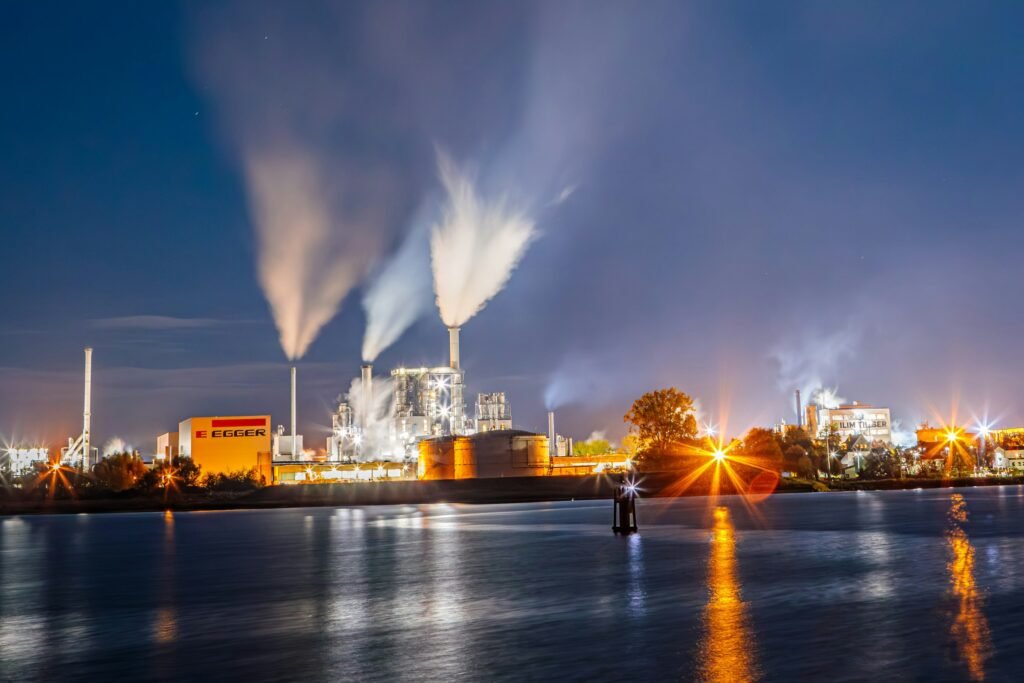
For German industry, the consequences are significant. As free allocation decreases, carbon costs rise for steel, cement, aluminium, fertilisers, hydrogen and other CBAM goods. At the same time, the Commission's review published on 17 July 2026 proposes to slow the phase-out and attach conditions to free allocation, and the revised Industrial Emissions Directive tightens permit requirements. Companies must plan investments against a moving legal target.
This article explains the current cap and free allocation rules, CBAM, the July 2026 proposal, the revised Industrial Emissions Directive and practical implications.
Cap and free allocation under current law
The EU ETS cap decreases each year by the linear reduction factor. Under Article 9 of the Emissions Trading Directive 2003/87/EC, as amended, the linear factor is 4.3% from 2024 to 2027 and 4.4% from 2028, with additional one-off reductions of the cap in 2024 and 2026. The result is a steep decline in the number of allowances available.
Free allocation is calculated on the basis of product benchmarks, historical activity levels and carbon leakage exposure. For goods covered by CBAM, Article 10a(1a) of the directive reduces free allocation by a CBAM factor. The CBAM factor is 97.5% in 2026, 95% in 2027, 90% in 2028, 77.5% in 2029, 51.5% in 2030, 39% in 2031, 26.5% in 2032 and 14% in 2033. From 2034, no CBAM factor applies – meaning that, under current law, free allocation for these goods ends. Allowances freed up by this reduction go to the Innovation Fund.
| Year | CBAM factor (share of free allocation retained) | Status |
|---|---|---|
| 2026 | 97.5% | Current law |
| 2027 | 95% | Current law |
| 2028 | 90% | Current law |
| 2030 | 51.5% | Current law |
| 2033 | 14% | Current law |
| 2034 | No free allocation for CBAM goods | Current law; Commission proposes extension to 2038 |
Conditions on free allocation
Already under the 2023 reform, free allocation is partly conditional. Installations subject to energy audits must implement recommendations or face a reduction, and installations with high emission intensity must prepare climate neutrality plans. These conditions will be strengthened under the Commission's proposal.
The carbon border adjustment mechanism
CBAM, established by Regulation (EU) 2023/956, applies to imports of iron and steel, aluminium, cement, fertilisers, hydrogen and electricity. After a transitional reporting phase, the definitive period began on 1 January 2026. Importers must be authorised CBAM declarants and will have to surrender CBAM certificates corresponding to the embedded emissions of their imports, reduced by any carbon price paid in the country of origin and by the free allocation still granted to EU producers.
The simplification regulation (EU) 2025/2083 introduced a single mass-based threshold of 50 tonnes per importer and year: importers below this threshold are exempt. It also postponed the sale of CBAM certificates on the common central platform to 1 February 2027. For German importers and producers in CBAM sectors, CBAM and the phase-out of free allocation are two sides of the same coin: as EU producers lose free allowances, importers pay a growing CBAM charge.
Downstream products and exports
CBAM currently covers basic materials and some simple products, not most downstream goods. This creates a risk that production of downstream products moves outside the EU. Exporters of CBAM goods also face higher costs without a border adjustment for exports. Both issues are part of the political debate and of the Commission's review.
The Commission's EU ETS reform proposal of July 2026
On 17 July 2026, the Commission published its proposal for a review of the EU ETS, aligned with the EU's 2040 climate target. According to the Commission's questions and answers, the key elements include:
- a lower linear reduction factor of 3.7% for 2031 to 2035 and 1.7% for 2036 to 2040;
- from 2031, full free allocation only for installations that prepare independently verified decarbonisation plans and invest an amount equal to the value of their free allocation in decarbonisation in the EU;
- a slower phase-out of free allocation for CBAM sectors, extended to 2038;
- integration of up to 250 million tonnes of permanent domestic carbon removals certified under the EU certification framework;
- a halving of the intake rate of the market stability reserve from 24% to 12%; and
- an Industrial Decarbonisation Bank with a target of EUR 100 billion, with a first phase financed by 400 million allowances.
The proposal now goes through the ordinary legislative procedure in the European Parliament and the Council. Its content may change considerably. Companies should treat the current rules as binding and the proposal as a scenario, not as settled law.
Implications of the proposal
If adopted, the proposal would give CBAM sectors more time and more free allowances, but it would also make free allocation dependent on investment commitments. Companies that receive free allocation would need credible decarbonisation plans and documented investments. This shifts the question from "how many allowances will we receive?" to "what must we invest to keep them?".
The revised Industrial Emissions Directive
Alongside emissions trading, the Industrial Emissions Directive (IED) governs permits for large industrial installations, with requirements based on best available techniques (BAT). The revised directive, Directive (EU) 2024/1785, had to be transposed by Member States by 1 July 2026 (Article 4). It introduces stricter emission limit values within BAT ranges, environmental management systems, new rules on penalties and compensation for damage to health, and the possibility of transformation plans that give operators time to implement deep industrial transformation. It also extends the scope to further activities.
In Germany, the IED is implemented mainly through the Federal Immission Control Act and its ordinances. Operators should check how the transposition affects their permits, particularly at the next permit review. Our article on immission control permits explains the permit system.
Build a single decarbonisation roadmap that covers EU ETS free allocation, CBAM exposure, IED permit requirements and funding. The same investment may be needed to keep free allowances, meet BAT requirements and qualify for climate protection contracts.
EU ETS reform timeline and legislative process
The current framework results from the 2023 EU ETS reform, which was part of the "Fit for 55" package aimed at reducing net greenhouse gas emissions by at least 55% by 2030 compared with 1990. That package also created CBAM, the separate emissions trading system for buildings and road transport, and the Social Climate Fund. The 2040 target, now set in the European Climate Law by Regulation (EU) 2026/667, requires a further revision of the ETS rules for the period after 2030, which is what the July 2026 proposal addresses.
The next EU ETS reform will be negotiated between the European Parliament and the Council during 2026 and 2027. Industry associations, Member States and environmental organisations have taken very different positions: some argue that the phase-out of free allocation threatens industrial competitiveness, while others argue that the proposal weakens the carbon price signal. The final compromise may differ substantially from the proposal, particularly on the phase-out timeline for CBAM sectors and on the conditionality of free allocation.
What stays the same
Whatever the outcome, the core mechanics remain: a declining cap, auctioning as the default, benchmark-based free allocation for sectors at risk of carbon leakage and annual surrender of allowances. Companies can therefore build their compliance processes on the current system and adapt parameters as the law changes.
Market stability and prices
The market stability reserve absorbs surplus allowances and releases them when supply is short. Changes to the reserve affect prices: a lower intake rate keeps more allowances in circulation, which tends to dampen prices. Because the EU ETS reform proposal combines a slower cap decline after 2030 with changes to the reserve, analysts expect a different price path than under current law. Companies hedging carbon costs should review their strategies once the legislative outcome becomes clearer.
Practical implications for companies
After the EU ETS reform, carbon costs are a central factor in industrial investment. Companies should model their allowance position under current law and under the Commission's proposal, including the CBAM factor, benchmark updates and conditionality. Long-term supply contracts for CBAM goods should allocate carbon costs and CBAM charges clearly, and procurement teams should verify embedded emissions data from non-EU suppliers.
Funding instruments can close the gap. Germany's climate protection contracts compensate the additional costs of low-carbon production, taking free allocation into account, and the EU Innovation Fund supports breakthrough technologies. For process emissions that cannot be avoided, carbon capture and storage may become a viable option as carbon prices rise.
Mergers and acquisitions
In transactions involving energy-intensive companies, buyers should analyse the target's allowance position, free allocation applications, compliance history, CBAM exposure and IED permit status. Changes in installations can affect free allocation, and the transfer of installations must be notified to the authorities.
Contracts with customers
Producers of CBAM goods should also review their sales contracts. As free allocation declines, carbon costs per tonne of product rise, and customers may resist price increases. Price adjustment clauses linked to carbon costs, clear definitions of "carbon cost" and rules for changes in law help to pass costs on in a transparent and enforceable way. For low-carbon products, contracts may include green premiums and certification requirements.
German administration
In Germany, the German Emissions Trading Authority (DEHSt) at the Federal Environment Agency administers free allocation, CBAM and compliance. Applications for free allocation for the next allocation period must be made on time and with verified data; mistakes can lead to lower allocation that is difficult to correct later. Objections against allocation decisions are subject to short deadlines, and court proceedings before the administrative courts can take years, so careful preparation of the application is the best protection.
How TRW & Co helps with the EU ETS reform
We advise energy-intensive companies, importers and investors on the EU ETS reform, CBAM and the revised Industrial Emissions Directive. We analyse allowance positions and free allocation, support CBAM authorisation and compliance, review supply contracts for carbon cost allocation, advise on permits and transformation plans, and represent clients before the DEHSt and the courts. Our work connects with our chemicals, manufacturing and compliance and ESG teams. Please contact us. This article is general information and not legal advice.
Frequently asked questions
When does free allocation end for CBAM sectors?
Under current law, free allocation for CBAM goods is reduced by a CBAM factor from 97.5% in 2026 to 14% in 2033, and ends in 2034. The Commission's proposal of 17 July 2026 would extend the phase-out to 2038, but it has not yet been adopted.
What does the July 2026 proposal change?
It would lower the linear reduction factor after 2030, make full free allocation from 2031 conditional on verified decarbonisation plans and investments, slow the CBAM phase-out, integrate permanent removals, halve the MSR intake rate and create an Industrial Decarbonisation Bank.
Which imports are covered by CBAM?
Iron and steel, aluminium, cement, fertilisers, hydrogen and electricity. The definitive period began on 1 January 2026. Importers below the 50-tonne annual threshold are exempt, and certificate sales start on 1 February 2027.
What is the revised Industrial Emissions Directive?
Directive (EU) 2024/1785 tightens permit requirements for large installations, including stricter emission limits, environmental management systems, penalties and transformation plans. Member States had to transpose it by 1 July 2026.
How should companies prepare?
Model allowance positions under current law and the proposal, prepare decarbonisation plans, review supply contracts for carbon costs and CBAM, check permits for IED changes and evaluate funding such as climate protection contracts.
Sources
General information only, not legal advice. References to statutes, courts and authorities describe published law and practice at the date shown.
 Energy & Climate
Renewable Energy Project M&A in Germany: Structuring and Due Diligence
Renewable energy project M&A is one of the most active transaction segments in Germany. Wind and solar projects change hands at every stage – from early… 8 min read
 Energy & Climate
The Greenhouse Gas Quota for Fuels: Obligations, Compliance Options and Trading
The greenhouse gas quota obliges companies that place petrol and diesel on the German market to reduce the greenhouse gas emissions of their fuels by a… 8 min read
 Energy & Climate
EV Charging Infrastructure: The Legal Framework in Germany
EV charging infrastructure in Germany is governed by a mix of EU and national rules: the EU Alternative Fuels Infrastructure Regulation (AFIR) sets coverage targets and… 8 min read